
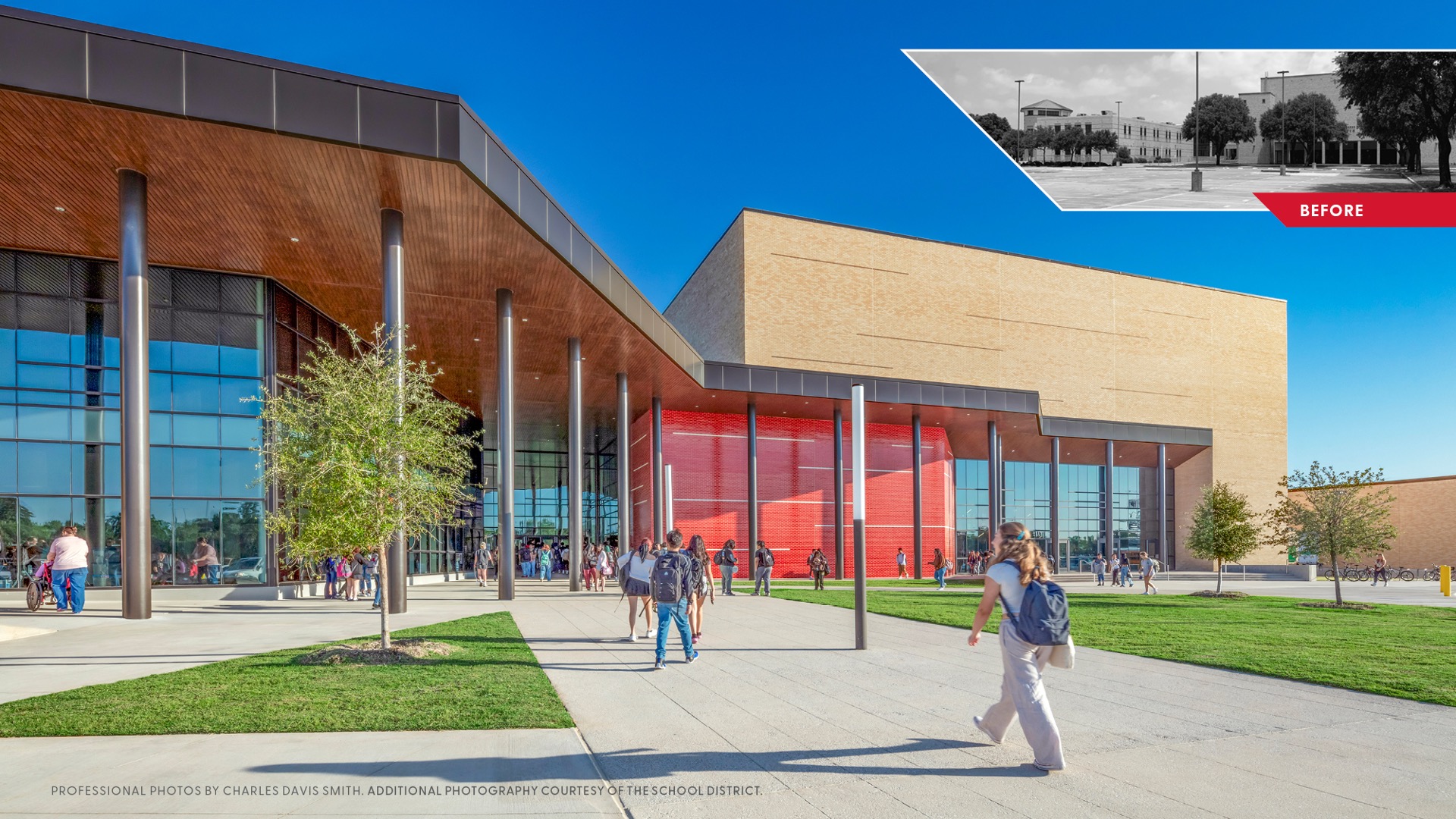


Richardson ISD — J.J. Pearce High School
Architect: Glenn | Partners
First opened in 1969, this historic high school underwent eight separate additions over the years, resulting in an unorganized, inefficient, and disjointed 495,000-square-foot campus with an outdated facade. It lacked the space and facilities required for evolving learning needs. Significant community involvement launched the school’s program into the future, prioritizing educational spaces that foster custom skills, real-world experiences, and next-generation critical thinking that reinforce future-ready learning for college and career. This completely transformed building prioritizes functional and flexible design that allows for growth, adaptable spaces, increased daylight, outdoor learning environments, and a transformed career and technical education (CTE) program. The high school is a transformation of architectural ideas, light, collaboration, and real-world academic learning. With bold interior graphics, a modernized theater, and a transformed exterior, this school stands as a welcoming staple in the community.
Design
“One main corridor connects the building and centralizes collaborative environments where students and education converge. Both career- and college-ready student programs drove the need for enhanced CTE space and Core Curriculum classrooms, including dedicated Robotics space for the school’s award-winning program. A variety of flexible spaces and movable features allow for student choice—open spaces are equipped for both collaboration and socializing, while private spaces allow for individual study. Visibility of student programs inspire exploration and discovery.”
Value
Transforming an existing school brought significant cost savings and enhanced value for the district, while also preserving the legacy and identity of the original site. A modernized facade gave the school a fresh, updated appearance, blending contemporary design with the familiar character of the original structure. Internally, the campus now offers improved efficiency, flexibility, and adaptability to support evolving academic and extracurricular needs. A major highlight of the transformation was the renovation of the theater and lobby, which now serves as a state-of-the-art venue for student performances and community events. This update reflects the school’s deep commitment to the arts, recognizing their vital role in student development and community engagement.
Wellness
The redesigned campus emphasizes student well-being, safety, and connection through thoughtful architectural planning. Increased daylighting and strategically placed windows enhance the indoor environment with natural light. Safety was a top priority. Redesigned parking lots and rerouted traffic flow enhances campus safety and efficiency. Distributing administrative spaces at both main entrances allows for consistent supervision and secure access. At the heart of the school is a vibrant central commons, a dynamic space that fosters unity, encourages movement, and serves as a hub for student activity. Surrounding this core are visible and accessible CTE and collaboration spaces, intentionally connected to the commons to highlight real-world learning and promote interdisciplinary interaction. The theater underwent renovations that increased safety and improved sound and visual quality, enhancing the experience for both students and patrons.
 Community
Given its rich history and prominent role in the community, it was essential that the facility’s identity and legacy be preserved through thoughtful design. The revitalized school now serves as a multi-purpose venue, hosting a variety of community events and performances, further strengthening the school’s role as a cultural and communal hub. At the heart of the community, the school serves a diverse student body with needs ranging from career-ready to college-preparatory curricula, supported by adaptable learning spaces. A refreshed and cohesive facade restores its visual prominence, while bold branding reinforces a strong sense of place and pride.
 Planning
Driven almost exclusively by community stakeholders, their input exposed current issues, uncovered the desired educational program outcomes, and informed the design. Five community meetings and a student survey revealed that this outdated campus had become congested and traffic flow was a challenge. They preferred an innovative campus inspired by today’s corporate workplaces that offer flexibility, opportunities for connection and collaboration, and outdoor spaces. They wanted a campus that students could be proud of and that was flexible for the future. From those meetings, five key project goals were articulated and then brought to life through the design. The renovation of this almost 500,000-square-foot facility was completed in three phases over three years. The phased approach allowed students to remain in the school, resulting in cost savings for the district.
 School Transformation
This once outdated and congested 1960s school was completely transformed into a modern, flexible, and welcoming facility that incorporates flexible furniture, bold graphics, and learning environments that inspire learning and a sense of place. It incorporates CTE programs that foster custom skills, real world experiences, and next-generational critical thinking. The central commons at the heart of the campus unifies students and teachers in one prominent location. Transparency and visibility of programs throughout inspire curiosity and motivates students.
 Star of Distinction Category Winner